Dance
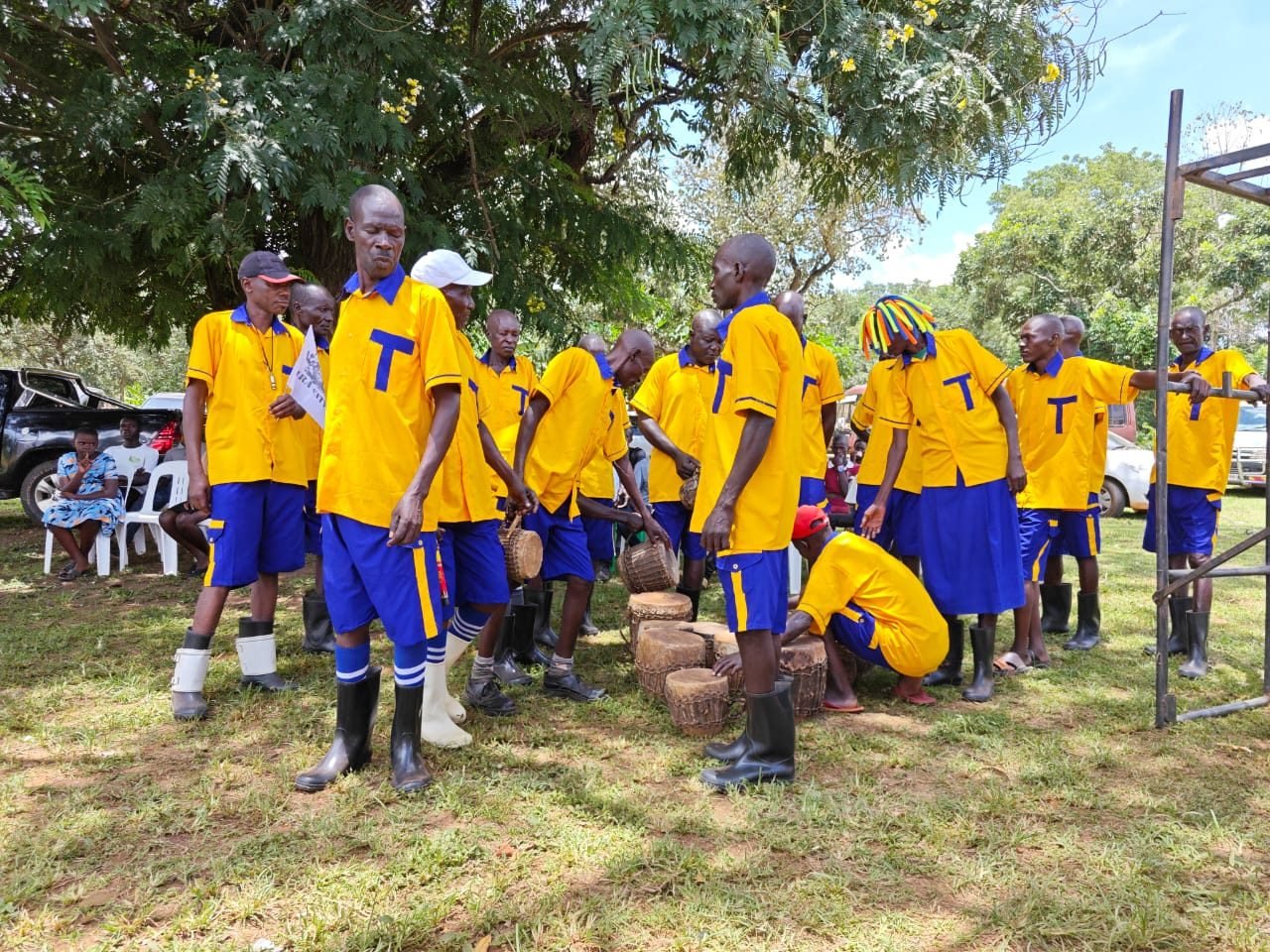
Myel me bul (the drum dance)
The commonest Lango dance of the early twentieth century: leaping in time to the drums.

Driberg called myel me bul (with drums) and myel me bilo (with flutes) the commonest of the many Lango dances. Men and women both took part.
- The dancers stood with their legs together and their arms bent forward, holding a stick. They jumped straight up, now and then flinging their legs out sideways with a shout or turning round in the air, and repeated it in perfect time for long stretches.
- Women and girls clicked their anklets together at every jump and tossed their heads so that their strands of hair flew.
- With the flute band, the men stood in a large circle facing inwards while the musicians moved about inside it. Girls followed the musicians, singing in a high voice, and the dancers joined in the chorus each time it came round.
- Older women, girls and children danced in groups around the outside. Dances took place in the late afternoon.
Driberg wrote that it was a fine exercise that took a great deal of stamina. See also Myel me bilo, Okeme, Abuda and Ikoce.
Source: J. H. Driberg, The Lango: A Nilotic Tribe of Uganda (London, 1923), pp. 126–128; public domain. It describes life about a hundred years ago as a colonial administrator saw it, so customs have changed and some may be told differently today. Elders and families are invited to correct it and add what they know.