
Traditional Attire
Beads, brass wire and ivory
Necklaces, coils of wire, ear and lip ornaments, and the ivory bracelet that marked chiefly descent.
Read moreBeaded caps, feather crowns and named haircuts: how Lango men dressed their hair a century ago.
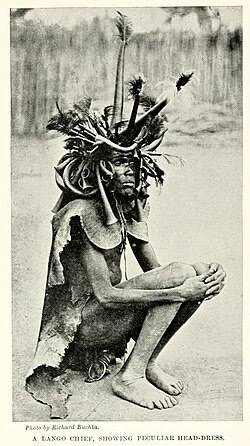
The Lango were known for the care they gave to their hair. The ethnographer J. H. Driberg described two main head-dresses worn by men.
In time the tok and the kono were made so that they could be taken off, and a round wicker tok, worked with the wearer’s own hair and decorated with rings of beaten brass, came into fashion. A warrior who had killed an enemy cut off his tok and hung it at his outdoor hearth, the otem.
Women did not cut their hair. They oiled it with croton or sesame oil mixed with ashes or chalk and twisted it into strands. Women dressed each other’s hair and charged nothing for it.
Source: J. H. Driberg, The Lango: A Nilotic Tribe of Uganda (London, 1923), pp. 58–61; public domain. It describes life about a hundred years ago as a colonial administrator saw it, so customs have changed and some may be told differently today. Elders and families are invited to correct it and add what they know.
Necklaces, coils of wire, ear and lip ornaments, and the ivory bracelet that marked chiefly descent.
Read moreLeather girdles, the ariko apron of metal chains and the skins used in Lango dress.
Read more